

Since the creation of ChatGPT in 2022 and the emergence of chatbots, Artificial Intelligence (AI) has rapidly evolved over the past few years. The development, from easily identifiable AI media to content that is difficult in distinguishing from reality, is remarkable, yet alarming. Because the boundaries of AI remain undefined, it is unclear whether AI-generated content poses risks such as creating illegal material, spreading misinformation, facilitating scams, or generating videos and images that reinforce harmful stereotypes. Although AI can be a valuable tool, misuse of it may negatively impact an individual’s cognitive abilities.
The potential future dangers of AI continue to spark ongoing discussion; however, society already faces pressing ethical concerns that require immediate attention. Generative AI can produce skewed or misleading content when trained on malicious, flawed, biased, or incomplete data, a phenomenon known as AI bias. According to Tableau, the biases of those who train these programs are often reflected in the data, resulting in both societal and data biases. Societal bias refers to real-world generalizations present in AI; data bias refers to invalid data used to develop an AI. Referencing outside sources will be crucial in mitigating bias, including harmful ideologies.
Junior Janelle Fiamordzi stated, “Although it makes life more convenient, I’m worried people could lose their jobs in the future.”
Artificial intelligence is also used to create deep fakes, fabricated videos that depict people saying or doing things they never did, often altering their appearance. With generative AI becoming more accessible, producing deep fakes is easier than ever, raising complex legal and ethical issues. Therefore, it is vital to develop the ability to distinguish deep fakes, and AI-generated content in general, from reality.
Junior Gabriella Gatti expressed, “Media literacy is important as we need to be able to differentiate reality from fantasy. With the use of AI, innocent people can be framed and children can be sexually exploited. If we cannot tell what is real and what isn’t, we cannot have a successful society.”
ChatGPT and similar AI tools can negatively affect critical thinking and information processing, with an even greater impact on developing brains. A research study from Duke University found that university students who use AI for writing tasks tend to exhibit weaker argumentation and reasoning skills compared to those who rely on traditional research methods. Furthermore, researchers found that students’ biased and surface-level analyses are often a result of using large language models (LLMs) that possess limited perspectives due to AI bias. This raises the question of how students can use AI effectively without hindering their ability to reason and problem-solve independently.
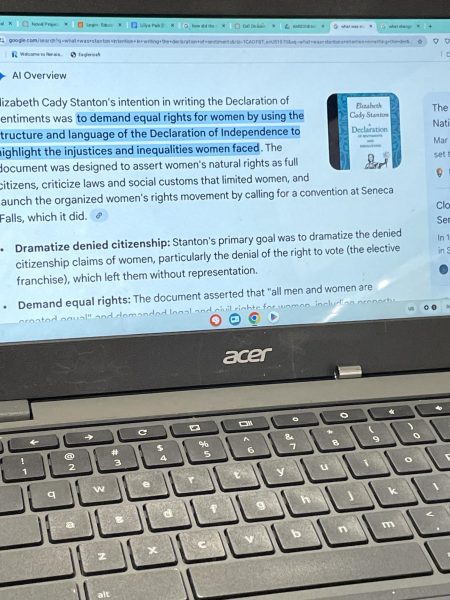
“It is detrimentally impacting education as it creates an environment that fosters laziness and increases the literacy crisis,” Gatti said. “Children need to learn to be comfortable with thinking, and AI doesn’t allow that. Schools should discuss AI’s dangerous impact on our environment, our brains, and our ability to think for ourselves.”
Generative AI is not inherently harmful, rather it depends on how it is used. ChatGPT and other AI chatbots can be useful tools when utilized responsibly, rather than spreading stereotypes or creating harmful images and videos. It can enhance human intelligence as opposed to replacing it. Instead of using chatbots as a search engine, use sites like Google for research projects and sources to eliminate misinformation. This allows for cognitive thinking and expanding skills such as problem-solving. Additionally, it can be used for brainstorming and receiving feedback.
Fiamordzi said, “Teachers could use AI as a self-checking tool to help students correct their work.”