
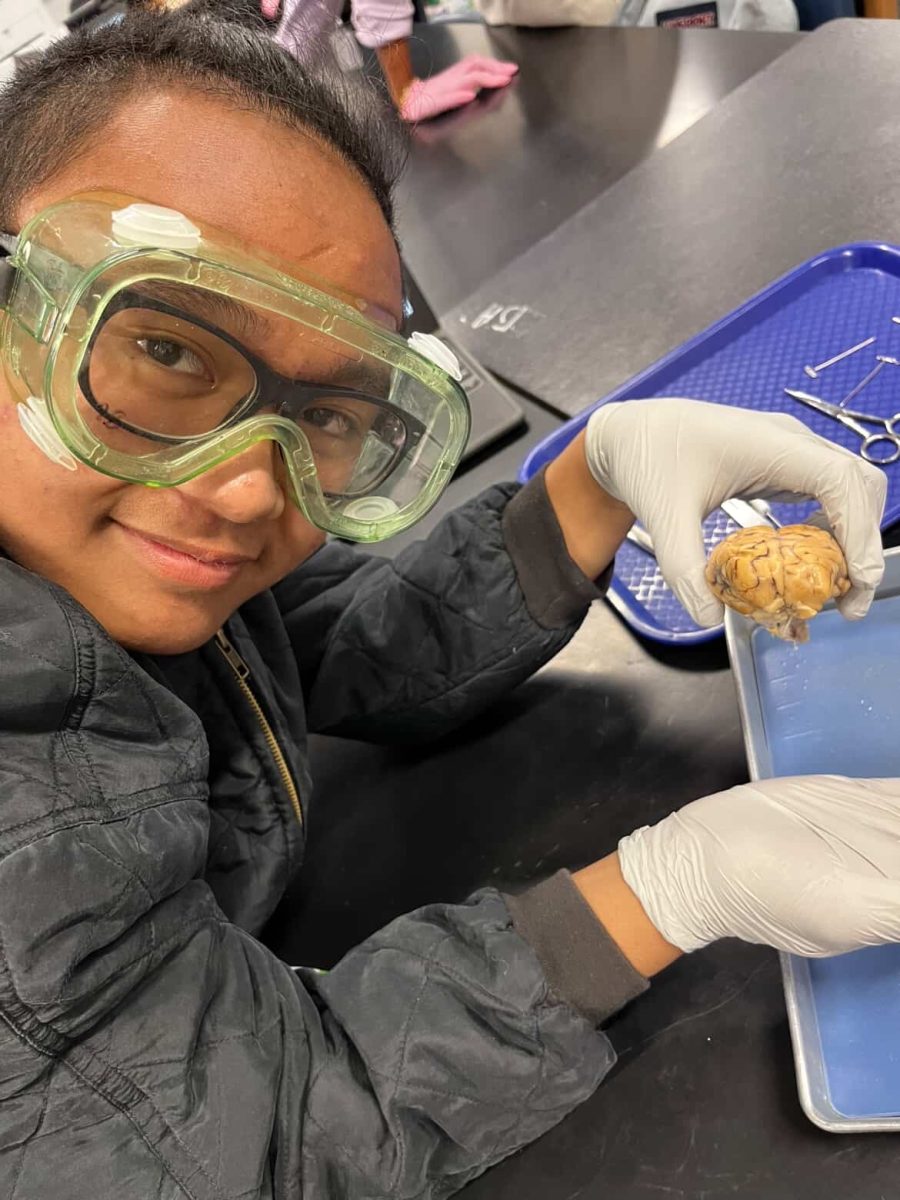
At Shadow Ridge High School, students in Principles of Anatomy and Physiology conducted a sheep brain dissection while learning about the nervous system. This hands-on activity gave students the opportunity to explore one of the two main parts of the central nervous system. The brain, as a vital structure, served as an excellent specimen for understanding how the central nervous system functions. Although students were provided with diagrams, examining a real brain allowed them to see, touch, and understand how all the individual structures discussed in class are connected. Through the dissection, students could better relate the brain’s structure to its function.
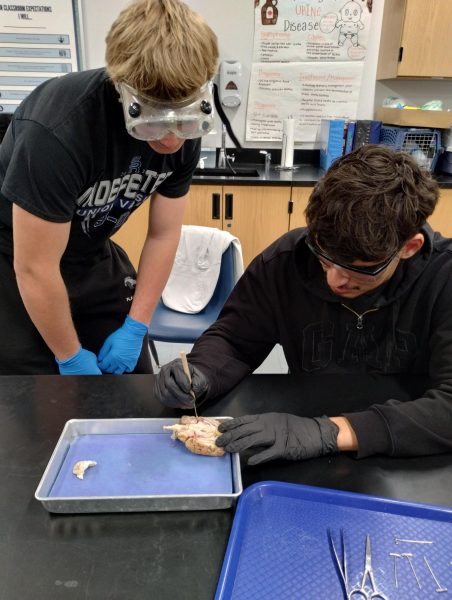
“With a real brain, students can visually appreciate the distinct right and left halves of the brain but also observe how they are still able to communicate with each other,” Keri Chambers, one of the Principles of Anatomy and Physiology teachers, states. “After identifying key structures, students also begin to understand how location affects function.”
From this experience, students learned many things about the central nervous system, such as how the occipital lobe processes visual information even though it’s located at the back of the brain. They saw the crisscrossing optic nerves that carry signals from the eyes to this area, making the visual pathway clear. They also observed the ventricles, where cerebrospinal fluid flows. This is only some of what they saw, and being able to visualize the information provided students with a deeper understanding that is difficult to represent on paper.
“The sheep’s brain was able to provide similar structures to the human brain, so it was easy for us to understand where everything is,” Raiden Capacio, junior states. “I think hands-on was more effective because diagrams, although they can be understood, make it much easier to have what you’re looking at right in front of you instead of on a screen or paper.”
While diagrams help introduce the parts of the brain, they don’t show everything you can see physically. During the brain dissection, students were able to examine the different lobes, nerves, and internal structures which made it easier to understand.
“I think dissections are definitely important for anatomy because they give students the opportunity to freely explore and learn for themselves,” Andrew Guevara, junior states.
Students were able to actively engage with material they had learned previously during the dissection. By identifying structures on their own and exploring the brain, they gained more understanding of how each part connects and functions.
Overall, the sheep brain dissection allowed students in Principles of Anatomy and Physiology to have hands-on experience while gaining new knowledge. These firsthand observations gave students a deeper appreciation of the central nervous system.