
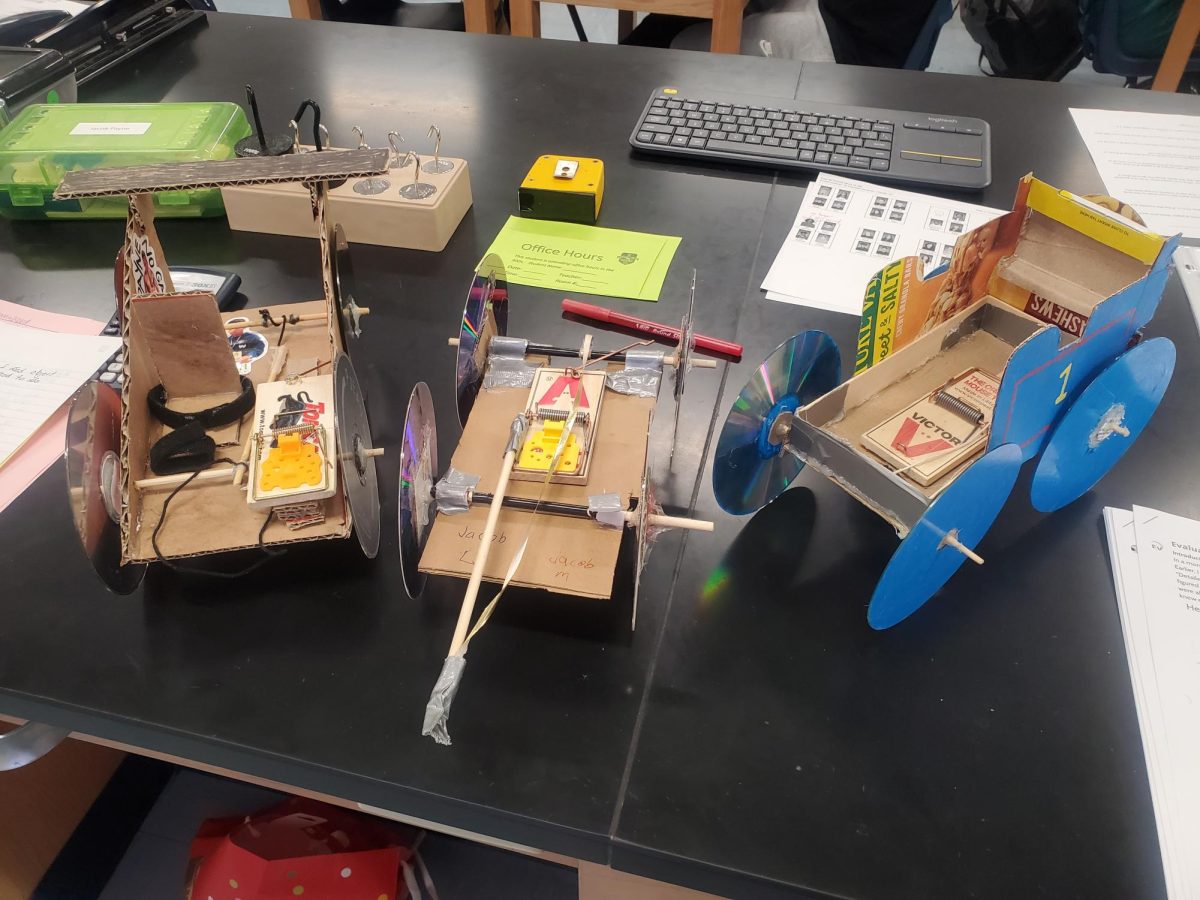
Every December, as finals season hits Shadow Ridge High School, AP Physics teacher Jacob Payne’s classroom turns into more of an engineering lab than a classroom. Each year, the semester concludes with a hands-on project in the form of a mousetrap car. This project is designed to be a demonstration of everything students have learned throughout the first semester. This project challenges students to apply physics concepts to a real mechanical system.
Payne says that the inspiration for this project went all the way back to his own senior year of high school, where they did the same project.
“What inspired me to do a project like the mouse trap car project as a final project was the final project that I did my senior year of high school for AP Physics C.” Payne stated, “Our final project was creating a mousetrap car. It was one of the projects that I enjoyed the most during high school. It was a very fun project to work on and it was very satisfying when it worked. It also incorporates many of the topics that we cover in physics, so you can think of it as a cumulative project.
The project incorporates a big part of the classes curriculum. Students apply concepts from kinematics to analyze motion and predict how the car will accelerate or slow down. They also use forces to understand what pushes and pulls on the car as it moves. They use energy and focus on how potential energy is turned into kinetic. Each section of the semester turns into a working part of the car, and pushes students to apply everything that they have learned so far.
Payne stated, “I hope the biggest thing they take away from this project is that learning physics can be fun. If they treat it as just another grade and wait until the last minute to do it, then it won’t be fun and they won’t get any enjoyment out of it.”
Still, Payne hopes that what students take with them from this project isn’t just academic, he wants students to see that learning and physics can be fun.

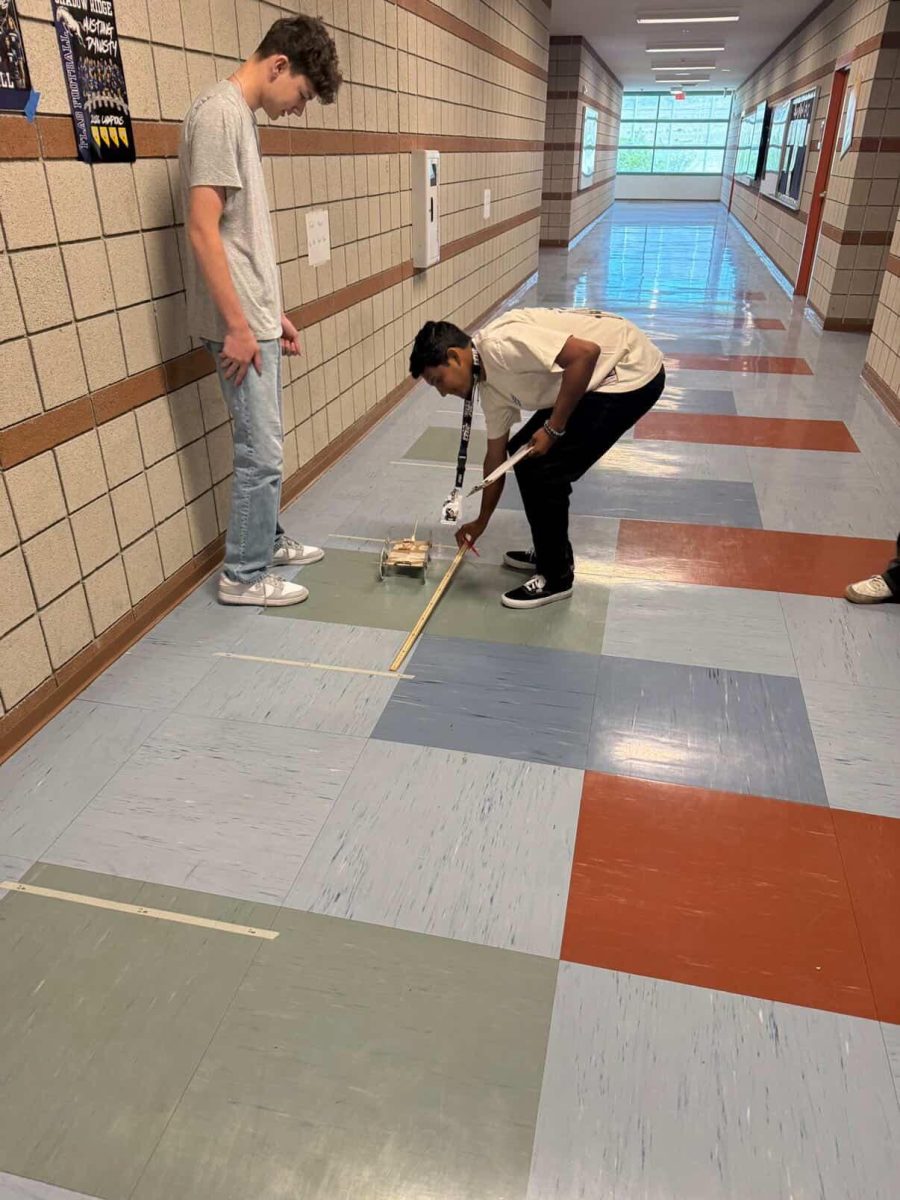
“Students are supposed to take very basic materials (mouse traps, cardboard, balloons, CDs, and create a little cart that can only be powered by the mousetrap. This mousetrap cart is supposed to go a specific distance between 2 and 5 meters that is determined on the day of the final. Their cart should be adjustable. Their first part is submitting a design plan, where I make sure that the students are only using allotted materials and methods to create this contraption. The second part is the construction of the cart. The third part is the cart execution, finding out whether the cart can complete the challenge or not.”
Whether every car hits the target distance or not, Payne hopes that the project gives students a deeper appreciation for applied physics, and experience the confidence that comes with building something from scratch.